
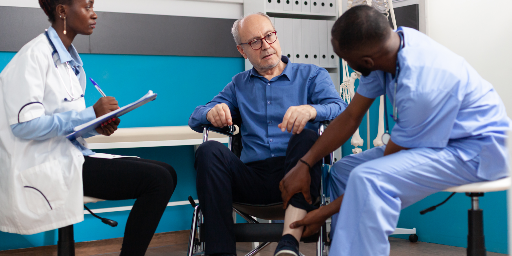
EXERCISES FOR KNEE PAIN

On the occasion of World Physiotherapy Day 2021, I would really like to discuss the causes, symptoms and the Physiotherapy management of knee pain.
Exercising may be the last thing you want to do when your joints are stiff and achy. But exercise is a crucial part of osteoarthritis treatment in order to ease pain and stay active.
Osteoarthritis is a degenerative joint disease that can affect the many tissues of the joint. Knee OA is the most common joint affected.Osteoarthritis occurs when cartilage, the tissue that cushions the ends of the bones within the joints, breaks down and wears away. In some cases, all of the cartilage may wear away, leaving bones that rub up against each other.

Causes of OA:
Factors that may contribute to the development of OA include:
Age. The risk of developing OA increases with age and symptoms generally, but not always, appear in people over 50.
Joint injury. A bone fracture or cartilage or ligament tear can lead to OA, sometimes more quickly than in cases where there is not an obvious injury.
Overuse. Using the same joints over and over in a job or sport can result in OA.
Obesity. Excess weight adds stress and pressure on a joint, plus fats cells promote inflammation.
Musculoskeletal abnormalities. Malalignment of bone or joint structures can contribute to faster development of OA.
Weak muscles. If muscles don’t provide adequate joint support, poor alignment can result, which can lead to OA.
Genetics. People with family members who have OA are more likely to develop it.
Gender. Women are more likely to develop OA than men.
Environmental Factors. Modifiable environmental risk factors include things like someone’s occupation, level of physical activity, quadriceps strength, presence or absence of prior joint injury, obesity, diet, sex hormones, and bone density.
Symptoms of OA:
Pain or aching in a joint during activity, after long activity or at the end of the day.
Joint stiffness usually occurs first thing in the morning or after resting.
Limited range of motion that may go away after movement.
Clicking or popping sound when a joint bends.
Swelling around a joint.
Muscle weakness around the joint.
Joint instability or buckling (as when a knee gives out).

How can Physiotherapy help in OA knee?

Physiotherapy should be started with all patients with a diagnosis of OA. Exercise has been proven to be effective as pain management and also improves physical functioning in the short term.
Exercises have to take place under the supervision of a Physiotherapist initially and when properly instructed these exercises can be performed at home.
Exercise helps to reduce pain and inflammation, normalises knee joint range of motion, and improves proprioception, agility and balance.
EXERCISES TO BE PERFORMED FOR OA KNEE:
1. Leg stretch:
Sit on the floor, with your legs stretched out straight in front of you. Slowly bend one knee up towards your chest, sliding your foot along the floor, until you feel a gentle stretch. Hold for five seconds. Straighten your leg as far as you can and hold in this position for five seconds. Repeat 10 times with each leg.

2. Quadriceps exercise with roll:
Sit on the floor, sofa or bed, with your legs stretched straight out in front of you. Put a rolled-up towel under one knee. Push down on the towel as if straightening your knee. Pull your toes and foot towards you, so that you feel your calf muscles stretch, and so that your heel lifts off the floor. Hold for 5 seconds, then relax for 5 seconds. Do this 10 times, and then repeat the exercise with the other.

3. Straight leg raise:
Sit with good posture in a chair. Straighten one of your legs, until you feel a stretch in the back of the leg. Hold for a slow count to 10 and then slowly lower your leg. Repeat 10 times with each leg. If you find this easy, straighten and raise one leg, before holding for a count of 10. Try to get into the habit of doing this exercise every time you sit down.

4. Sit to stand:
Sit on a chair. Without using your hands for support, stand up and then sit back down. Make sure each movement is slow and controlled. Repeat as many times as you like. Rest for one minute, then repeat another couple of times. If the chair is too low, start by putting a cushion on the seat and remove it when you don’t need it anymore.

5. Step ups:
Step onto the bottom step of stairs with your right foot. Bring up your left foot, then step down with your right foot, followed by your left foot. Hold on to the bannister if you need to. Repeat with each leg until you can’t do any more. Rest for one minute, then repeat this another couple of times. As you improve, use a higher step.

6. Knee squats:
Hold onto a chair or work surface for support. Squat down until your kneecap is directly over your big toe. Hold for a count of 5, then return to your normal standing position. Repeat as many times as you like, rest for one minute, then repeat another couple of times. As you improve, try to squat a little further, but don’t bend your knees beyond a right angle.

All the exercises mentioned above should be done on a regular basis. I hope all of these exercises help you to reduce knee pain and maintain a healthy lifestyle.
You will start to see all of the many benefits that come with doing exercises regularly.
Stay positive on the journey to a fitter, healthier and more flexible you.
Keep Going
Stay fit, Stay Strong
Below is a video I am attaching for your reference on how to do these exercises:
https://www.youtube.com/watch?v=VWMxjFuYHPc
SOURCES:
BY DR.KIRAN ANIL PALANDE
(CARDIOPULMONARY PHYSIOTHERAPIST)