
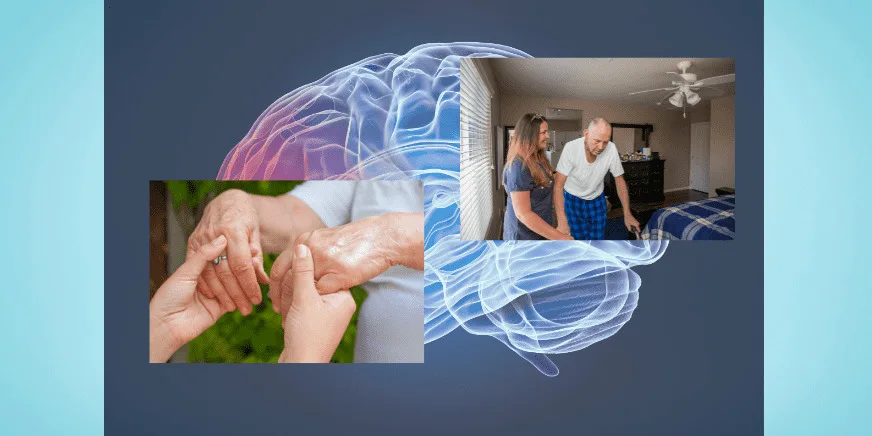
Parkinson’s disease is an age-related degenerative brain condition, meaning it causes parts of your brain to deteriorate. It’s best known for causing slowed movements, tremors, balance problems and more. Most cases happen for unknown reasons, but some are inherited. The condition isn’t curable, but there are many different treatment options.
What is Parkinson’s disease?
Parkinson’s disease is a condition where a part of your brain deteriorates, causing more severe symptoms over time. While this condition is best known for how it affects muscle control, balance and movement, it can also cause a wide range of other effects on your senses, thinking ability, mental health and more.
Who does it affect?
The risk of developing Parkinson’s disease naturally increases with age, and the average age at which it starts is 60 years old. It’s slightly more common in men than in women. While Parkinson’s disease is usually age-related, it can happen in adults as young as 20 (though this is extremely rare, and often people have a parent, full sibling or child with the same condition).
How common is this condition?
Parkinson’s disease is very common overall, ranking second among age-related degenerative brain diseases. It’s also the most common motor (movement-related) brain disease.
Symptoms
Parkinson's disease signs and symptoms can be different for everyone. Early signs may be mild and go unnoticed. Symptoms often begin on one side of the body and usually remain worse on that side, even after symptoms begin to affect the limbs on both sides.
· Tremor. A tremor, or rhythmic shaking, usually begins in a limb, often your hand or fingers. You may rub your thumb and forefinger back and forth. This is known as a pill-rolling tremor. Your hand may tremble when it's at rest. The shaking may decrease when you are performing tasks.
· Slowed movement (bradykinesia). Over time, Parkinson's disease may slow your movement, making simple tasks difficult and time-consuming. Your steps may become shorter when you walk. It may be difficult to get out of a chair. You may drag or shuffle your feet as you try to walk.
· Rigid muscles. Muscle stiffness may occur in any part of your body. The stiff muscles can be painful and limit your range of motion.
· Impaired posture and balance. Your posture may become stooped. Or you may fall or have balance problems as a result of Parkinson's disease.
· Loss of automatic movements. You may have a decreased ability to perform unconscious movements, including blinking, smiling or swinging your arms when you walk.
· Speech changes. You may speak softly, quickly, slur or hesitate before talking. Your speech may be more of a monotone rather than have the usual speech patterns.
· Writing changes. It may become hard to write, and your writing may appear small.
Causes
In Parkinson's disease, certain nerve cells (neurons) in the brain gradually break down or die. Many of the symptoms are due to a loss of neurons that produce a chemical messenger in your brain called dopamine. When dopamine levels decrease, it causes atypical brain activity, leading to impaired movement and other symptoms of Parkinson's disease.
The cause of Parkinson's disease is unknown, but several factors appear to play a role, including:
Genes. Researchers have identified specific genetic changes that can cause Parkinson's disease. But these are uncommon except in rare cases with many family members affected by Parkinson's disease.
Environmental triggers. Exposure to certain toxins or environmental factors may increase the risk of later Parkinson's disease, but the risk is small.
Risk factors
· Age. Young adults rarely experience Parkinson's disease. It ordinarily begins in middle or late life, and the risk increases with age. People usually develop the disease around age 60 or older.
· Heredity. Having a close relative with Parkinson's disease increases the chances that you'll develop the disease. However, your risks are still small unless you have many relatives in your family with Parkinson's disease.
· Sex. Men are more likely to develop Parkinson's disease than women.
· Exposure to toxins. Ongoing exposure to herbicides and pesticides may slightly increase your risk of Parkinson's disease.
Complications
Parkinson's disease is often accompanied by these additional problems, which may be treatable:
· Thinking difficulties. You may experience cognitive problems (dementia) and thinking difficulties. These usually occur in the later stages of Parkinson's disease. Such cognitive problems aren't usually helped by medications.
· Depression and emotional changes. You may experience depression, sometimes in the very early stages. Receiving treatment for depression can make it easier to handle the other challenges of Parkinson's disease.
· Emotional changes: You may also experience other emotional changes, such as fear, anxiety or loss of motivation. Health care providers may give you medication to treat these symptoms.
· Swallowing problems. You may develop difficulties with swallowing as your condition progresses. Saliva may accumulate in your mouth due to slowed swallowing, leading to drooling.
· Chewing and eating problems. Late-stage Parkinson's disease affects the muscles in the mouth, making chewing difficult. This can lead to choking and poor nutrition.
· Sleep problems and sleep disorders. People with Parkinson's disease often have sleep problems, including waking up frequently throughout the night, waking up early or falling asleep during the day.
· Sleep behavior disorder People may also experience rapid eye movement sleep behavior disorder, which involves acting out your dreams. Medications may improve your sleep.
· Bladder problems. Parkinson's disease may cause bladder problems, including being unable to control urine or having difficulty in urinating.
· Constipation. Many people with Parkinson's disease develop constipation, mainly due to a slower digestive tract.
· Blood pressure changes. You may feel dizzy or lightheaded when you stand due to a sudden drop in blood pressure (orthostatic hypotension).
· Smell dysfunction. You may experience problems with your sense of smell. You may have difficulty identifying certain odours or the difference between odours.
· Fatigue. Many people with Parkinson's disease lose energy and experience fatigue, especially later in the day. The cause isn't always known.
· Pain. Some people with Parkinson's disease experience pain, either in specific areas of their bodies or throughout their bodies.
Prevention
Because the cause of Parkinson's is unknown, there are no proven ways to prevent the disease. Some research has shown that:
· Regular aerobic exercise might reduce the risk of Parkinson's disease.
· People who consume caffeine — which is found in coffee, tea and cola — get Parkinson's disease less often than those who don't drink it.
· Green tea is also related to a reduced risk of developing Parkinson's disease.
However, it is still not known whether caffeine protects against getting Parkinson's or is related in some other way. Currently there is not enough evidence to suggest that drinking caffeinated beverages protects against Parkinson's.
- Edited & compiled by Anita Natu
Find out how diet & exercise can help manage Parkinson’s, by clicking on this link:
https://vayah-vikas.org/article-info/MANAGING-PARKINSON'S-WITH-EXERCISE-&-DIET-/Mzc3
Click here for Physical, Occupational & Speech therapy for Parkinson’s patients:
https://vayah-vikas.org/article-info/REHABILITATION-THERAPY-FOR-PARKINSON%E2%80%99S-PATIENTS/Mzc2
Sources:
https://www.mayoclinic.org/diseases-conditions/parkinsons-disease/symptoms-causes/syc-20376055
https://my.clevelandclinic.org/health/diseases/8525-parkinsons-disease-an-overview