
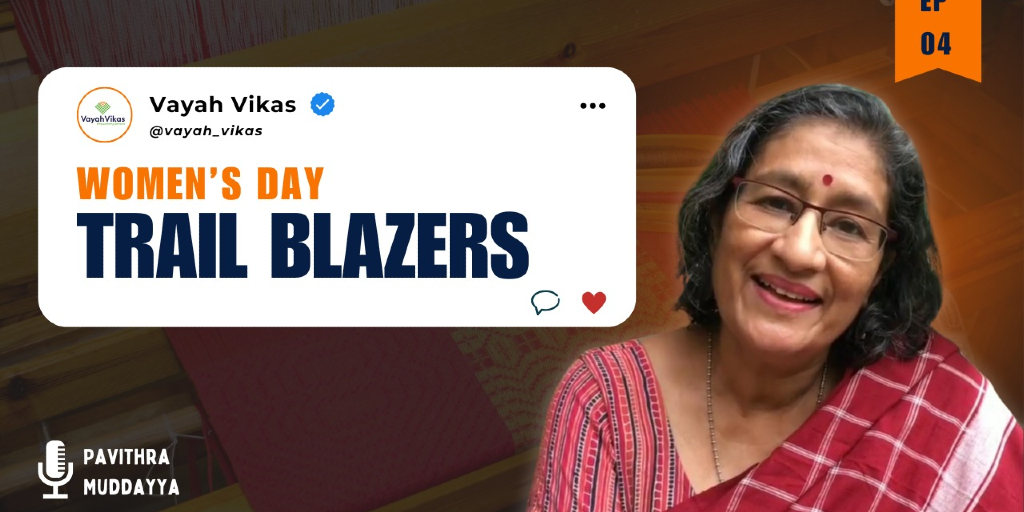
On the occasion of Women's Day, Vayah Vikas proudly recognizes Pavithra Muddayya as a Timeless Trailblazer, honoring her invaluable contributions to the handloom industry and her unwavering commitment to empowering weaver communities.
Weaving Heritage into Contemporary Threads
Pavithra Muddayya is a distinguished figure in handloom revival, seamlessly blending tradition with modernity through her work with the Vimor Handloom Foundation and the Vimor Museum of Living Textiles. Her unwavering dedication to India’s weaving heritage has ensured that artisans receive the recognition and dignity they rightfully deserve.
Renowned for her efforts in preserving and reviving traditional Indian textiles, particularly Karnataka’s iconic sarees, Pavithra has been the driving force behind Vimor, a brand committed to sustaining India’s rich handloom legacy. Her contributions extend beyond fabric, embodying the resilience, pride, and craftsmanship of generations of weaver families who continue to uphold this cherished tradition.
A Legacy Woven with Purpose
Born into a family that deeply valued Indian traditions, Pavithra inherited her passion for textiles from her mother, Chimmy Nanjappa. Vimor, founded in 1974, was not just a commercial venture but a mission to empower weavers, revive fading traditions, and ensure that handloom craftsmanship remained relevant in modern times.
Her early exposure to the art of weaving—watching her mother mentor weavers and revive age-old patterns—shaped her commitment. Pavithra seamlessly carried forward this vision, ensuring that every saree woven under Vimor's banner tells a story of heritage, resilience, and artistic mastery. Under her leadership, Vimor has resurrected numerous forgotten designs, drawing inspiration from temple murals, historical manuscripts, and heirloom pieces, thereby preserving textile heritage while providing livelihoods to countless artisans across Karnataka and beyond.
A Champion for Weavers
Beyond design revival, Pavithra has been instrumental in advocating for the welfare of handloom weavers. She has worked closely with artisans, ensuring fair wages, improved working conditions, and a platform to showcase their skills. Her work has inspired many young designers to embrace sustainable and ethical fashion, creating a renewed appreciation for handmade textiles.
She believes that sustaining handlooms is not merely about selling sarees but about empowering the weaver. Pavithra has often spoken about the struggles artisans face—from financial instability to a lack of recognition. By mentoring young weavers and helping them develop a business mindset, she has enabled many to become independent entrepreneurs, breaking away from exploitative supply chains.
Recognition and Impact
Pavithra’s contributions to India’s textile industry have been widely recognized. Vimor has collaborated with the Government of India, design institutions, and heritage conservationists to document and preserve textile traditions. She has mentored numerous weavers and designers, ensuring the continuity of skills that might otherwise have been lost.
Her influence extends beyond India, as textile connoisseurs from around the world appreciate Vimor’s collections for their authenticity and timeless appeal. Through exhibitions, lectures, and collaborations, she continues to educate people about the importance of sustaining handloom traditions. Her work has been featured in international forums, highlighting how India's weaves are more than just fabric—they are living pieces of history.
Weaving a Legacy: A Journey of Empowerment and Innovation
One of the most significant challenges in this journey was shifting weavers' perceptions of themselves from wage laborers to skilled artisans capable of independent success. A core aspect of her mission was instilling pride and confidence in weavers by emphasizing the global value of their craftsmanship. A risk-free model was introduced, offering advances and buyback guarantees to eliminate market uncertainties. This approach ensured stability, allowing artisans to concentrate on their craft without the burden of financial insecurity or travel for sales.
Innovation was another cornerstone of this initiative. Weavers were encouraged to experiment with their own designs without financial risk—any unsold creations were personally worn, reinforcing their value. This fostered creativity and confidence, helping sustain traditional arts despite declining interest from younger generations and the widespread crisis of weaver suicides.
Unlike conventional business models, this approach focused on empowerment rather than ownership. Without claiming patents or geographical indications, designs were shared freely, inspired by pioneers like Kamaladevi, who championed India’s artisans. This philosophy enabled many weavers to expand their operations, with some growing from two looms to nearly a hundred. Encouragingly, the next generation—often armed with engineering or business degrees—has returned to their roots, revitalizing the craft with entrepreneurial vigor.
Vision for the Future
Looking ahead, she aspires to document her 50-year journey in the industry through a book that captures the stories of weaver empowerment. While many encourage her to focus on her personal experiences, she insists that the narrative should center on the craft and the people who sustain it.
Pavithra Muddayya's long-term vision is clear: to allow the brand’s future to evolve organically. She believes that the next generation should have the freedom to shape its course, without feeling bound by legacy. While she remains unattached to the notion that Vimor must endure indefinitely, one principle remains unwavering—never turning away a weaver in need.
Championing Policy Change and Fair Pricing
Beyond her entrepreneurial endeavors, Pavithra is a staunch advocate for policy reforms in the handloom sector. She challenges outdated practices, particularly the widespread discounting of handwoven products. “In 75 years, we’re still offering a 20% discount on handlooms. Why do we devalue our own artisans when we readily pay full price at multinational stores?” she questions.
Handlooms, once a cornerstone of India’s economy, are now dismissed as a ‘sunset industry’—a notion she finds deeply frustrating. “We have thousands of years of expertise in this craft. Why are we letting go of something so valuable?” she asks.
She highlights structural issues plaguing the industry, from policies favoring power looms and synthetic fabrics to the financial instability of artisans. Many weavers struggle with debt, taking small loans to sustain their work, only to be burdened by repayment challenges.
Aging with Purpose and Confidence
Reflecting on her journey, Pavithra finds aging empowering. “As I’ve aged, I feel more confident and independent. Opportunities came to me earlier too, but I didn’t always have the courage to take them up. Now, my attitude is: How many more years do I have? I’m going to do whatever I want to do.”
Celebrating a True Trailblazer
Pavithra Muddayya’s passion for preserving India’s handloom heritage and her dedication to empowering artisans make her a true inspiration. Vayah Vikas is honored to celebrate Pavithra as a Timeless Trailblazer. Her journey exemplifies how one individual’s passion can create a lasting impact on an entire industry and community.