
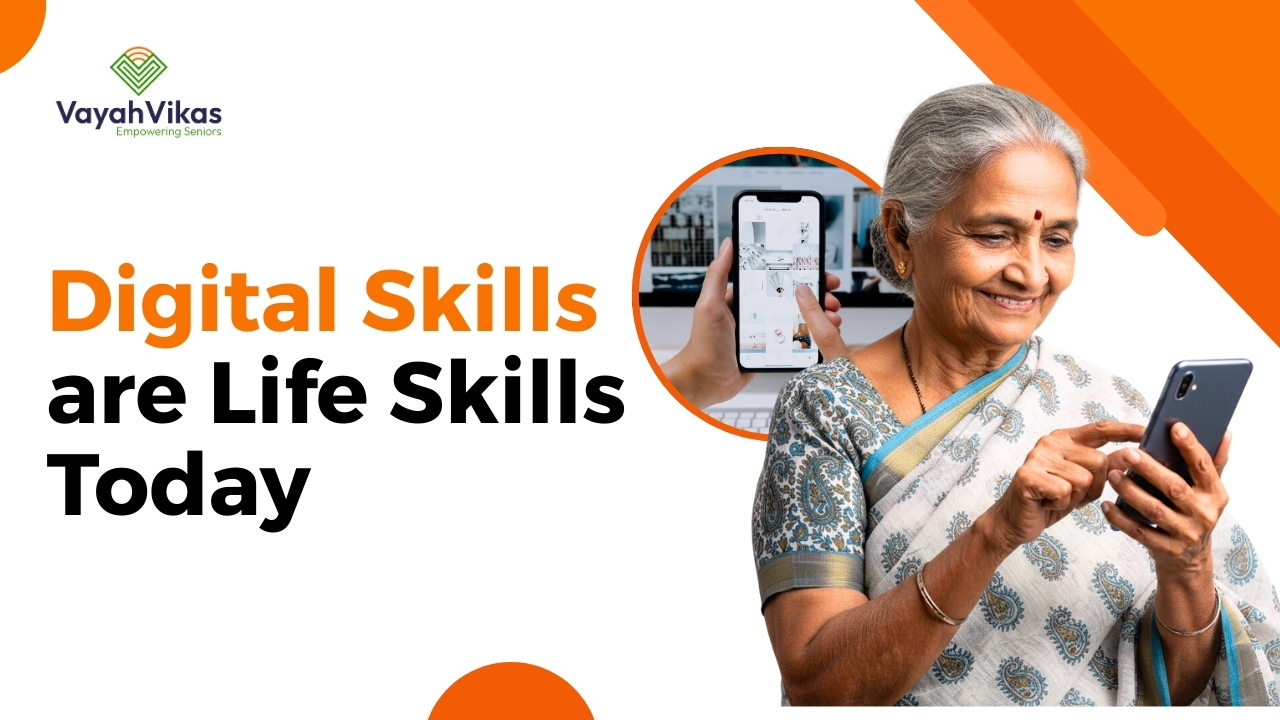
For today’s older adults, the digital world is no longer a parallel universe inhabited only by the young. It is the world where banking happens, healthcare is accessed, government services are delivered, and families stay connected. From booking a doctor’s appointment to receiving pension updates, from paying utility bills to joining a grandchild’s birthday on video call, digital touchpoints now sit at the heart of everyday life. In this context, digital literacy is no longer a “nice to have” skill for seniors. It is essential for independence, dignity, safety, and participation in society.
Yet, many older adults continue to approach technology with hesitation. This is not because of a lack of ability, but because digital systems are often designed without them in mind. Small fonts, complex interfaces, jargon-heavy instructions, and the fear of making irreversible mistakes can create barriers. Add to this the real and growing threat of online fraud, and digital exclusion becomes both a social and a personal risk.
Digital literacy for seniors, therefore, goes far beyond learning how to use a smartphone. It is about building confidence, understanding digital behaviour, and knowing how to navigate the online world safely and purposefully.
Why digital literacy matters more than ever
The shift to digital-first services has accelerated rapidly in recent years. Healthcare platforms now rely on apps and portals for appointments, reports, and teleconsultations. Financial ecosystems increasingly encourage digital payments and online banking. Government schemes, subsidies, and essential services are often accessible only through websites or mobile applications. Without basic digital skills, seniors risk being dependent on others for tasks that directly affect their autonomy.
Equally important is the social dimension. Digital tools can reduce isolation by enabling seniors to stay connected with family, peer groups, and communities. When used well, technology can support mental wellbeing, lifelong learning, and active ageing.
Vayah Vikas: Building confidence, not just competence
At Vayah Vikas, we believe digital literacy for older adults must be practical, patient, and rooted in real life. Our focus is not on teaching technology in isolation, but on enabling seniors to use digital tools meaningfully and safely in their everyday lives. Through our MoU with the Ministry of Social Justice and Empowerment, we aim to expand the reach of this work and build wider awareness around digital literacy, ensuring more older adults have the confidence and skills to navigate an increasingly digital world.
Our digital literacy initiatives combine in-person workshops and interactive webinars designed specifically for older learners. In physical sessions, Shankar Ranganathan, Head of Operations, Vayah Vikas, along with his team, works with small groups, allowing participants to learn at their own pace, ask questions freely, and practice repeatedly. Topics range from basic smartphone use and WhatsApp features to UPI payments, accessing government portals, and identifying online scams.
Webinars help us reach seniors across geographies and create shared learning spaces beyond physical boundaries. Across all formats, our trainers place equal emphasis on mindset and skills, reinforcing that mistakes are a natural part of learning and that curiosity and confidence do not have an age limit.
Case study 1: From fear to financial confidence
Meera, a 68-year-old retired schoolteacher, attended one of our in-person digital workshops with a clear admission: she was afraid of using her phone for anything beyond calls. Digital payments felt risky, and she relied on her son for all banking-related tasks. Over a series of guided sessions, Meera learned how to use UPI safely, understand transaction alerts, and recognise red flags for fraud. Today, she pays her bills independently, checks her bank messages with confidence, and no longer feels anxious when handling money digitally. What changed was not just her skill set, but her sense of control.
Case study 2: Staying connected, staying engaged
Ramesh, 72, lives alone in a different city from his children. During one of our webinars on smartphone basics, he learned how to use video calls, join interest-based WhatsApp groups, and watch curated health content on YouTube. Encouraged by follow-up videos from Vayah Vikas, he now participates in online discussions, attends virtual wellness sessions, and feels more connected to a community. For him, digital literacy became a bridge to social engagement, not just a technical upgrade.
Case Study 3: Srinivas
Srinivas, 65, had never used computers beyond the most basic level. Digital tools felt intimidating, and he relied on others for tasks that required computer use. Applications like Excel were completely unfamiliar to him. Through a structured and patient learning process, Srinivas was introduced to core computer skills, starting with simple navigation and gradually moving to practical applications. The focus was on everyday use rather than technical complexity.
Today, Srinivas is comfortable working on a computer. He uses Excel to organise data, perform basic calculations, manage records, and handle email and documents independently. His journey shows that with the right approach, prior experience is not a prerequisite for becoming digitally capable.
Looking ahead
As India’s older population continues to grow, digital inclusion must be seen as a cornerstone of healthy and dignified ageing. Digital literacy empowers seniors to make informed choices, protect themselves, and remain active participants in an increasingly digital society.
At Vayah Vikas, we remain committed to ensuring that no older adult is left behind simply because the world has gone online.
Because in today’s world, digital skills are not optional. They are life skills.