
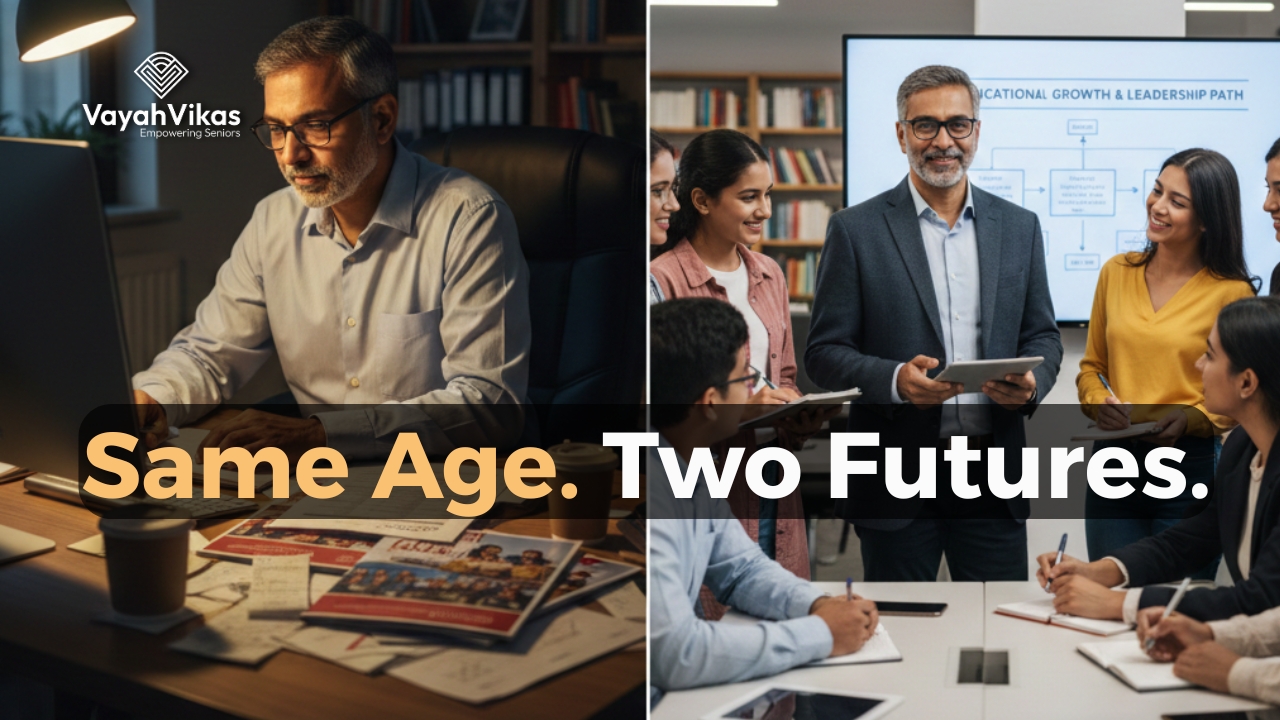
In a quiet apartment complex in Bengaluru, a professional at a large IT firm is approaching 50. He has spent over two decades building a stable career, yet today he lies awake at night worried about layoffs. His children are just entering college, education loans and EMIs are ongoing, and financial responsibilities are far from over. He knows he is not alone.
This anxiety surfaced repeatedly during our 2025 roundtables with HR leaders, DEI heads, and CXOs across sectors. Beneath discussions on talent pipelines and digital transformation lay a shared concern: what happens to employees in midlife as industries change faster than ever before?
Longer lives, longer careers
Longevity has fundamentally altered the nature of work. With life expectancy rising and health spans improving, many people can expect to live active, productive lives well into their seventies and beyond. Yet our career models remain anchored to an outdated assumption: that professional relevance peaks by the late forties and retirement follows soon after 60.
For today’s midlife adults, this gap between lifespan and career span is widening. Financial realities make early retirement unrealistic, while rapid technological change makes skill obsolescence a constant threat. Retirement planning is no longer about the last five years of work; it must now account for an additional 15 to 20 years of employability.
The midlife squeeze
Midlife is often the most demanding phase of life. Professionals are managing senior roles, caring for ageing parents, and funding their children’s education. Job loss or stagnation at this stage carries far greater consequences than it does earlier in one’s career.
Despite this, midlife workers are frequently overlooked in learning and development strategies. Training budgets and growth opportunities tend to favour early career employees, while older workers are quietly assumed to be less adaptable or less interested in learning. Evidence from both research and lived experience suggests the opposite: motivation to reskill is often highest when the stakes are real and immediate.
Reskilling as risk management
Midlife reskilling is no longer a personal ambition; it is a form of risk management for individuals and organisations alike. For professionals, acquiring new skills can mean the difference between vulnerability and resilience. For employers, investing in midlife talent preserves institutional knowledge while reducing the costs of constant hiring and churn.
Reskilling at this stage does not always mean learning to code or starting from scratch. It may involve transitioning into adjacent roles, developing digital fluency, strengthening leadership or mentoring capabilities, or building expertise in emerging areas such as compliance, sustainability, data interpretation, or customer experience.
What organisations can do
The conversations with corporate leaders in 2025 highlighted a growing awareness that ageing workforces are not a problem to be managed, but a resource to be developed. Forward-looking organisations are beginning to:
- Design learning pathways specifically for midlife and senior professionals
- Offer flexible roles, project-based work, and internal mobility options
- Recognise experience as an asset that complements new skills
- Normalise continuous learning at every age, not just early career
Such approaches also support diversity, equity, and inclusion goals by addressing age as a critical, yet often ignored, dimension of workplace equity.
A cultural shift in how we view age and work
At a societal level, we need to move away from linear career narratives that equate age with decline. In an era of longevity, relevance must be renewable. Learning cannot stop at 40 or 45; it has to be woven into the entire adult life course.
For the professional worried about layoffs at 50, reskilling is not just about staying employed. It is about dignity, security, and the confidence to face a longer future. As careers stretch across decades, midlife learning is no longer optional. It is the cornerstone of sustainable work in an ageing world.
Conclusion
The realities of longer lives and longer working years demand a rethink of how we approach careers, learning, and ageing. Midlife reskilling is no longer a niche concern or a personal fallback plan. It is central to economic security, organisational resilience, and social well-being. As more professionals find themselves navigating uncertainty in their forties and fifties, the need for supportive ecosystems that enable continued learning and reinvention becomes urgent.
At Vayah Vikas, we believe these conversations must move beyond policy papers and boardrooms into shared action. If you, your organisation, or your community are working on initiatives that support midlife learning, age-inclusive workplaces, or extended careers, we would like to hear from you. By learning from one another and staying engaged, we can shape a future of work where age is not a barrier, but a strength.